Fishing game mechanics explained in plain language
Casting, depth, line tension and drag appear in almost every fishing game. This guide explains these ideas simply so they feel familiar in whichever game you choose.
Why the basics carry across games
Fishing Planet, Russian Fishing 4, Ultimate Fishing Simulator and Call of the Wild: The Angler each have their own systems, but they share a common foundation. All of them ask you to place bait or a lure where fish are, recognise when a fish is interested and bring it in without breaking your line.
Once you understand these ideas, every fishing game becomes easier to learn. The details differ, but the logic stays much the same. This article covers the core concepts in the order you usually meet them on the water.
The journey of a single catch
Most catches in fishing games follow a similar sequence.
- 01
Choosing where to cast
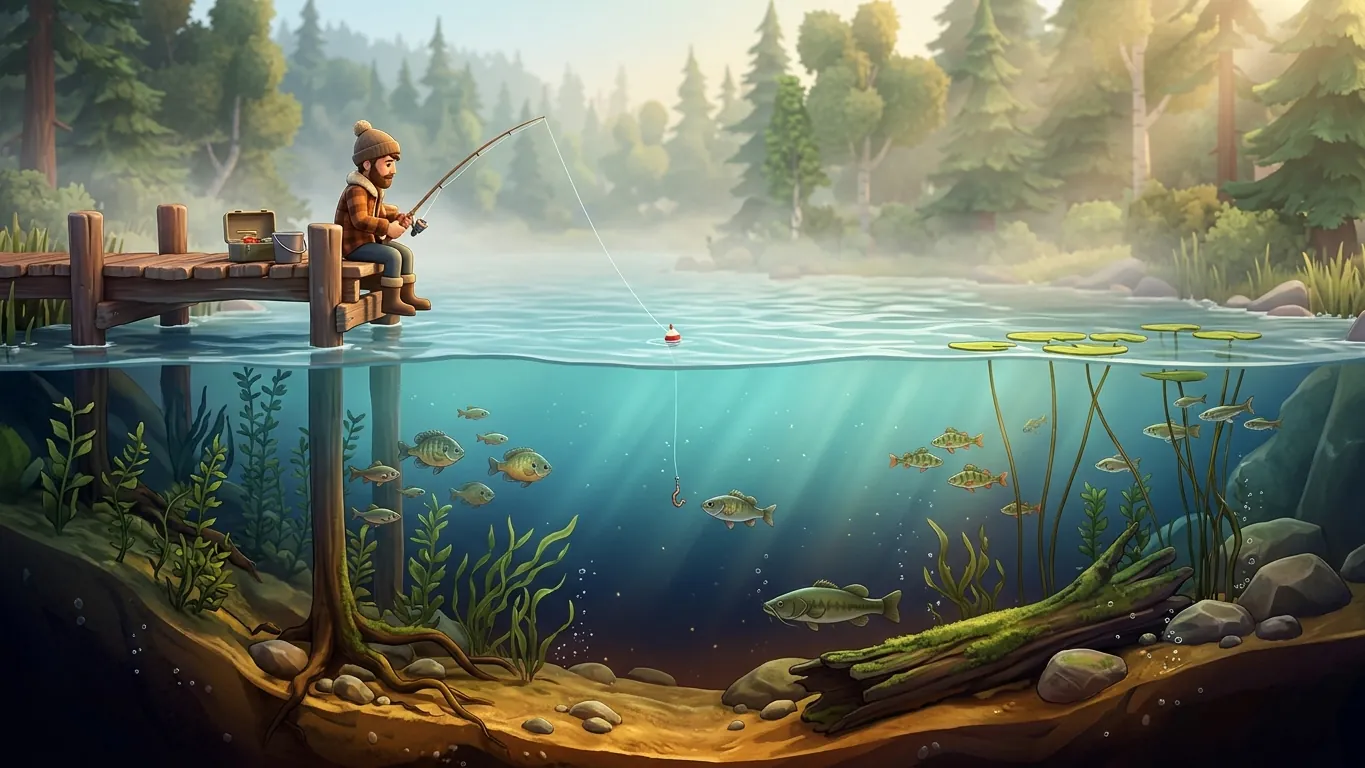
Fish gather around features such as plants, drop-offs, rocks and inflowing water. Casting near these areas usually gives better chances than open, featureless water.
- 02
Reaching the right depth
Different fish prefer different depths. Floats, sinkers and lure types control how deep your bait sits, so adjusting depth is often the key to getting bites.
- 03
Reading the bite
A moving float, a twitching rod tip or a change in line behaviour signals interest. Games show this in different ways, and learning to read them takes practice.
- 04
Setting the hook and reeling in
Once the fish takes the bait, you hook it and begin the fight, balancing reeling with line tension so the fish tires without the line breaking.
Line tension and drag
Line tension is one of the most important ideas in any fishing game. When a fish pulls, the tension on your line rises. If it becomes too high, the line or another part of your setup may fail. If it stays too low, the fish may escape.
Drag is the reel's way of managing this. It lets the line slip out under heavy pressure instead of snapping. A looser drag protects your line but makes the fight longer, while a tighter drag gives more control but increases risk. Many games let you adjust drag and show tension visually, so watching that indicator and easing off when it climbs is a habit worth building.
With larger fish, a patient approach usually works better than reeling constantly. Let the fish run when it pulls hard, then gain line when it slows down.
Time, weather and conditions
Many fishing games simulate changes in time of day and weather, and fish behaviour often responds to them. Some species may be more active in the early morning or evening, while others respond to temperature or light.
You do not need to memorise every pattern. A practical habit is to notice when bites become more or less frequent and to try another depth, location or bait when activity drops. Over time, you will start to recognise patterns in the game you play most.
Learning without frustration
The best way to learn fishing mechanics is to change one thing at a time. If you are not getting bites, adjust only the depth first, then the bait, then the location. Changing several things together makes it hard to know what made the difference.
Remember that empty sessions are part of fishing, both real and virtual. Each one teaches you something about how the game models fish behaviour. With that mindset, the mechanics become an interesting puzzle rather than an obstacle.
Related articles
 Why slow play suits fishing games so well
An opinion piece on enjoying fishing games at a calm pace, with ideas for relaxed sessions in Fishing Planet, Russian Fishing 4 and others.
Read more
 How to choose a fishing game that fits the way you play
Match Fishing Planet, Russian Fishing 4, Ultimate Fishing Simulator or The Angler to your interests: tackle, exploration, relaxation or mechanics.
Read more
 Fishing Planet: what new players should know
An independent look at Fishing Planet: how its progression, gear and techniques work, and which kind of player it may suit best.
Read more